
Advancing ion and plasma propulsion systems for atmospheric flight, aerospace systems, and silent UAV architectures, from first-principles modelling to experimental hardware.
Empirical and analytical study of electrode geometry, collector radius, and spacing on thrust-to-power ratio in ionic wind generators — building on experimental prototypes toward optimised configurations.
Characterising ionisation, charge transport, and plasma sheath formation in low-temperature discharge environments relevant to electric propulsion and atmospheric flight.
Propulsion systems operating within planetary atmospheres — electrohydrodynamic (EHD) thrusters and hybrid plasma-aerodynamic mechanisms for silent, fuelless flight.
Translation of electric propulsion research into low-observable, acoustically silent UAV platforms — where propulsion silence is a strategic capability, not just an engineering preference.
To develop the next generation of electric and plasma propulsion systems — grounded in rigorous physics, built in working hardware, and oriented toward applications that matter.

Ongoing and completed research spanning ionic thruster hardware, propulsion analysis, and electric propulsion theory. All experiments are self-designed and physically built.
Developing a novel triad-method for assessing plasma propulsion efficiency using Optical Emission Spectroscopy. The approach aims to bring plasma propulsors one step closer to viable launch assistance by providing a richer diagnostic picture than single-instrument methods. Conducted under the Furim Institute Forward Looking Minds Fellowship.
An exploratory study applying quantum wave dynamics analysis to a representative electrohydrodynamic thruster model, integrated with a Physics-Informed Neural Network (PINN). The work sits at the intersection of quantum mechanics, plasma physics, and machine learning — pushing toward a more complete theoretical description of EHD propulsion phenomena.
Extended essay and substantial improvement on prior work. Systematically investigated how electrode spacing and collector radius affect thrust-to-power ratio in a self-built EHD ion thruster — treating geometry as the primary design variable. Presented at KUF 2026 national finals.
A research proposal investigating the use of nanomaterial-based electrodes as a route to substantially improved plasma propulsion efficiency. The proposal examines how engineered nanoscale electrode surfaces could reduce energy losses, enhance ionisation rates, and push the thrust-to-power ratio toward ranges relevant for space launch applications.
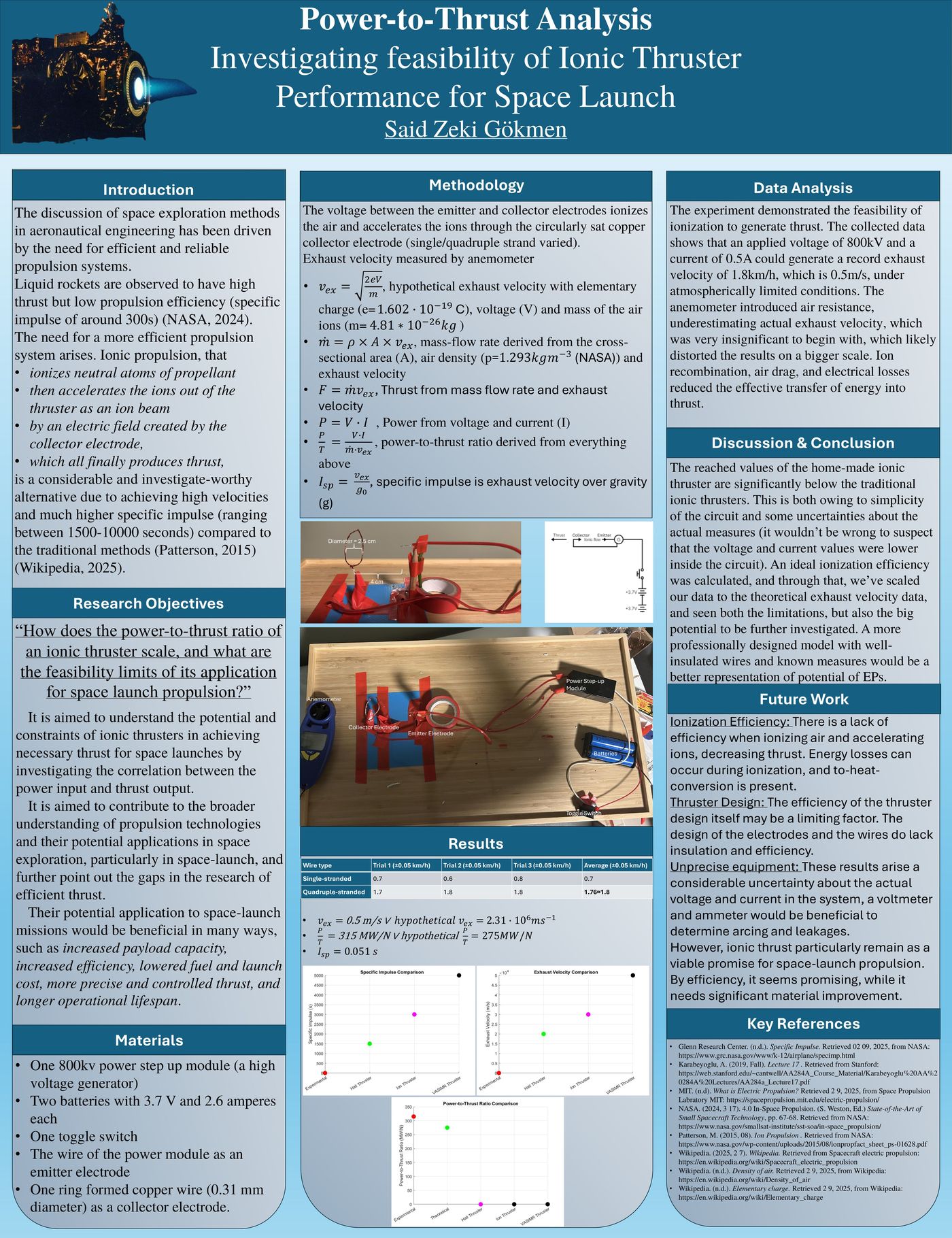
Investigated the power-to-thrust ratio of a self-designed and self-built small-scale ionic thruster. Explored scalability to traditional thruster sizes, validated experimental data against theoretical predictions, and examined potential optimisations for maximum thrust — ultimately assessing whether electric propulsion can serve as an alternative to chemical propulsion for space launch. Published as a preprint on engrXiv.
Investigates the power-to-thrust ratio of a self-designed and self-built small-scale ionic thruster. The study explores scalability to traditional thruster sizes, validates experimental data against theoretical predictions, and examines potential optimisations for maximum thrust. Estimates performance in vacuum environments and critically evaluates whether electrohydrodynamic propulsion can serve as a viable alternative to chemical propulsion for space launch — challenging the prevailing view that electric propulsion is unsuitable for launch-phase missions.
Independent researcher building an early-stage propulsion program around ionic and plasma systems, with a focus on atmospheric EHD propulsion, electric propulsion diagnostics, and long-horizon aerospace applications. Two consecutive years of nationally competitive research, a published preprint, a working thruster prototype, and a long-term trajectory oriented around deep physics and propulsion engineering — at MIT, Caltech, or Princeton, and beyond.
Furim Institute Forward Looking Minds Fellow. Driven by the same conviction that shaped the engineers behind the first ion drives: electric propulsion is where aerospace is heading.
National science competition. Project: electrode spacing and collector radius effects on thrust-to-power ratio in an ionic thruster. Qualifies for European Space Camp.
Selected to attend European Space Camp following KUF 2026 placement. Annual programme hosted at Andøya Space Center, Norway.
Competitive fellowship recognising exceptional early-career researchers with forward-looking impact potential in science and technology.
National science competition. Project: power-to-thrust analysis of a self-built ionic wind generator.
"Power-to-Thrust Analysis: Investigating Feasibility of Ionic Thruster Performance for Space Launch." DOI: 10.31224/5626. ORCID authenticated. CC BY 4.0.
Gokmen Research is building a small, output-driven network of researchers working on plasma and electric propulsion. If your work touches any of the areas below, reach out.
Researchers working on EHD thrusters, ion drives, Hall thrusters, or plasma sheath physics at any level — student, postdoc, or faculty. Output-oriented collaboration only.
Physicists or engineers applying PINNs, CFD, or quantum simulation methods to propulsion or plasma problems. Active intersection with the quantum-EHD study underway.
Experimentalists with OES, Langmuir probe, or thrust-stand experience. The OES triad-method project has immediate opportunities for co-authorship.
Engineers or analysts with interest in electric propulsion for low-acoustic UAV platforms. Translation of lab results into applied systems is a core long-term direction.
Send a brief note about your work and what kind of collaboration you have in mind. No formal pitch needed — a paragraph is enough.
Gokmen Research operates across three distinct tiers of electric propulsion — from working hardware demonstrated today to the high-power systems that define the long horizon.
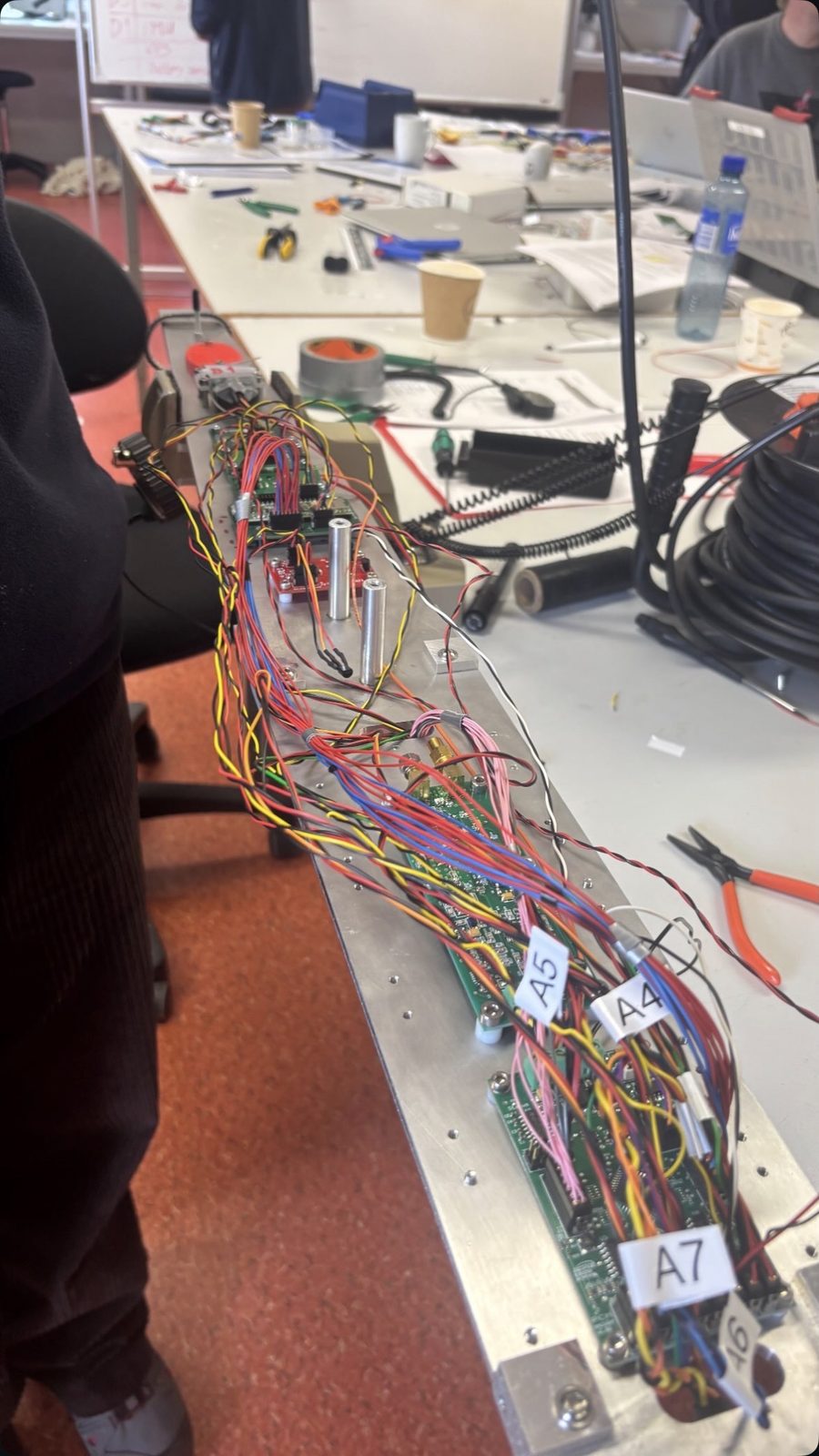
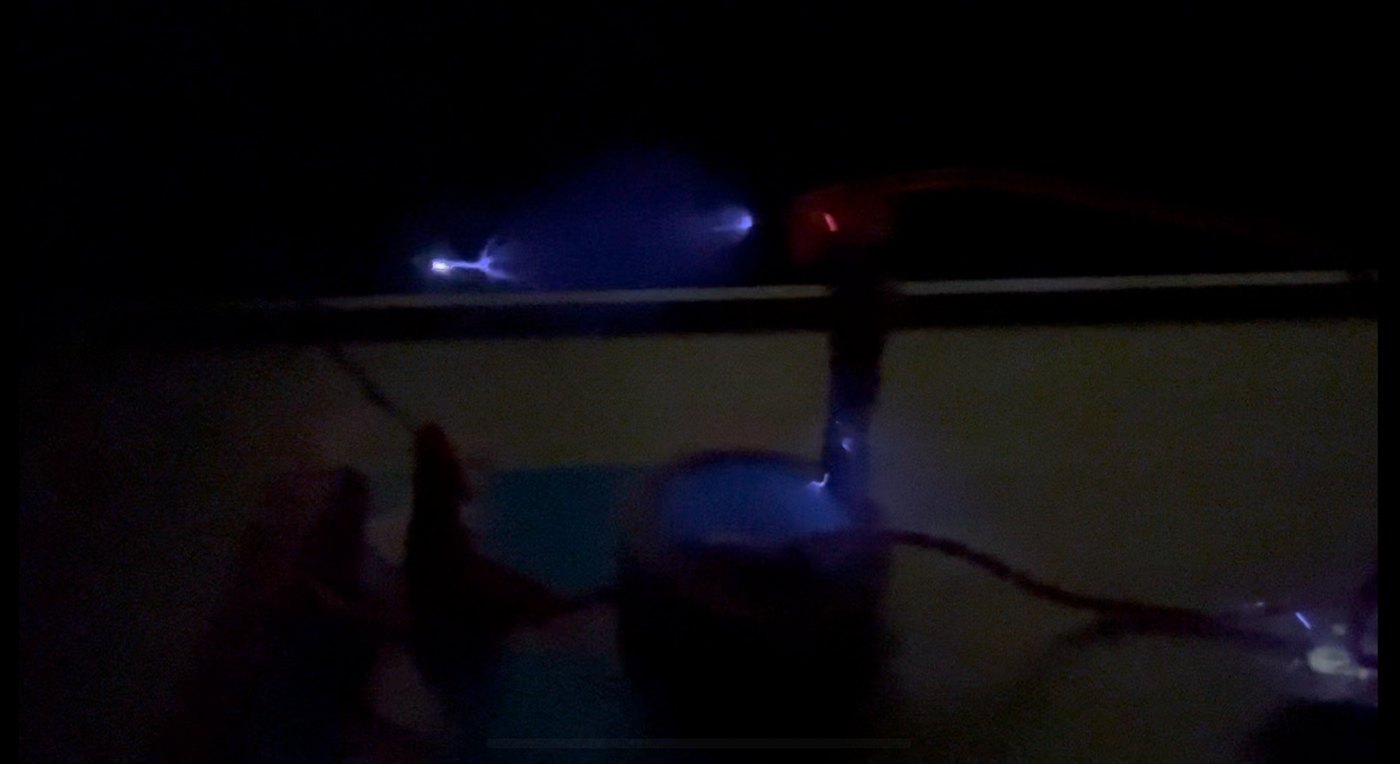
The foundation of the independent research initiative. Electrohydrodynamic thrusters operating in atmospheric conditions — no propellant storage, no combustion, no moving parts. Ionised air is accelerated directly by high-voltage electrode fields to generate thrust. All prototypes are self-designed, self-built, and tested in-lab. This is where the first-principles physics was validated, the KUF datasets were generated, and the two publications were produced.
EHD / Ionic Wind Atmospheric Self-built Hardware PublishedA miniaturised gridded ion thruster developed under the Furim Institute Forward Looking Minds Fellowship. Ion thrusters accelerate propellant ions through electrostatic grids to achieve high specific impulse. At the microscale, grid spacing, aperture geometry, and beam neutralisation become the critical engineering variables. This project bridges the lab-scale ionic work of the initiative with the space-grade architecture of flight-heritage electric propulsion.
Gridded Ion Micropropulsion Furim FellowshipElectrospray propulsion extracts and accelerates charged droplets or ions directly from a liquid propellant surface using high electric fields. Uniquely suited to ultra-small spacecraft where volume and mass constraints rule out most other propulsion options. The Furim collaboration explores this technology as a precision attitude-control and fine-manoeuvring system, with a long-term eye on CubeSat and pico-satellite platforms.
Electrospray Colloidal Thruster Furim FellowshipThe most commercially credible branch of the long-term vision. Hall thrusters occupy the zone where industry buys, NASA flies, and universities push toward higher power — making them the strongest bridge between current research capability and serious scaling ambition. The thrust density, efficiency, scalability, and engineering maturity of Hall thrusters outperform most alternatives for a founder building from real products toward high-power systems. The X3 nested Hall thruster exists precisely because teams are pushing Hall above 100 kW while keeping device dimensions and throttling practical. This is also the only branch where large-scale in-space propulsion — orbit tugs, cislunar logistics, high-power transfer vehicles — is not a fantasy.
The long-term moonshot branch. If the goal is very-high-power plasma propulsion, MPD is substantially closer to that identity than PPT, standard electrospray, or gridded ion. Princeton's Lorentz-force work and recent literature confirm MPD as a serious research path for higher-thrust electric propulsion. MPD is not the first company product — brutal power demands, electrode erosion, materials stress, harder test infrastructure, and a weak near-term customer path make that impractical. But MPD is what the programme grows into, built on the Hall thruster foundation.
MPD Lorentz Force Very High Power Long-term R&DElectric heating of atmospheric air or creation of plasma jets for propulsion within planetary atmospheres. Unlike EHD which relies on ion drift, this branch uses direct plasma heating or arc-jet mechanisms to generate thrust. A parallel applied direction with near-term relevance to high-altitude aircraft, drone platforms, and specialised aerospace systems where chemical fuel is a liability.
Electrothermal Air-Breathing Plasma Atmospheric FlightNot atmospheric aircraft — satellites skimming very low Earth orbit and ingesting residual atmosphere as propellant. ABEP systems eliminate the need to carry propellant, enabling indefinite station-keeping in VLEO where drag is significant and propellant mass budgets are prohibitive. The intersection with the EHD and gridded ion work is direct: ionising atmospheric gas and accelerating it efficiently is the shared physics across all four branches.
ABEP VLEO Satellites Propellant-Free Drag Compensation